
Painted Veils
A devotion to identity

As a teenager, I fell in love with a boy no one would have predicted. Where I was a straight-A student, he was in a perpetual state of almost-failing. Where I was punctual, he was always late. Where I was cautious, quiet, and anxious, he was irreverent, loud, and theatrical. When I succeeded, it was through diligence and focus that bordered on obsession. When he succeeded, it was through a sudden flash of intuition.
“You never, ever practice,” our band teacher said to him one afternoon, exasperated. We’d just sight-read an arrangement we would spend three months rehearsing. As always, I’d stood behind the marimba through every agonizing stanza, the mallets in my hands, my eyes darting furiously between our director’s waving arms and the lines of suddenly indecipherable dots careening at across my sheet music. Without hours to memorize each chord and melody, I was too paralyzed to play anything at all. Meanwhile, Alex glided through the trombone solo in the second movement so effortlessly I could see the joy and despair fighting across our teacher’s face. By the day of our concert, I’d play my part without error, but Alex, caught distracted in the bright lights of the stage, stumbled over the notes he’d played so beautifully that first afternoon.
To say no one would have predicted Alex and I would fall in love is not to say that anyone questioned it once it happened. Opposites seem completely disconnected when viewed in isolation, inseparable once joined. As John Berger once wrote:
With all those whom we are not in love, we have too much in common to be in love. Passion is only for the opposite.
This is old wisdom, cliché even. Opposites attract. Passion comes from a desire to experience all the things that we are not. The timid soul wonders what it would be like to walk the earth as a dare devil. The on-the-grind social climber craves a the slow, restful mind of a homebody. I—obedient and people-pleasing teenager that I was—lusted after Alex’s brash disregard for convention or criticism. As he and I walked the high school hallways, lingered beside each others’ lockers, and touched furtively in sheltered corners, the adults who knew us looked on with with confusion, bemused knowing, or trepidatious waiting. Because how could it be that we’d chosen each other? How could we have chosen anyone else?
To conceive of the loved one as all that the self is not means that together the lovers form a totality. Together they can be anything and everything. This is the promise which passion makes to the imagination.
When he and I were together, joined in all our opposites, everything seemed possible. Worlds opened up. We filled journal after journal of poems to and about each other. We imagined shared futures, shared presents, shared pasts. I’d met him in middle school when he’d moved to my hometown from upstate New York, but who was to say our souls hadn’t somehow known each other since birth? Who was to say we didn’t see with a clarity the jaded adults around us could not? Who was to say that we—mortal beings doomed to the grave—hadn’t found in each other eternity?
Of course our years together were volcanic. We broke up a dozen times, confessed undying devotion, flung ourselves back toward each other. By college we were still careening —shouting accusations as the sun set, eyeing engagement rings as morning broke, always dancing between extremities. One evening of that stormy season, I sat across from him on the gummy carpet of my dorm room, a candle lit between us. He’d started dating someone else a few months before, but we met in my room almost every evening. Crouched in the dark, he opened a small, velvet pouch and placed a series of small, polished stones on the floor before him—quartz, garnet, chrysocolla, amethyst.
“Here,” he said, handing me a small, round lump of obsidian. “Close your eyes. Tell me what you see.”
Suspicion glanced through me. What exactly was he expecting to happen? I took the bit of glassy stone and stared at it, smaller than a marble, translucent and smokey. When I looked up again, his eyes were expectant, his shoulders hunched toward me, lips slightly parted. I wanted to please him. I sensed, in a desperate, self-obliterating way, that if I only said the right words in this moment, he would leave his new girlfriend and choose me again. I’d enter infinity.
I pressed the obsidian between my palms, tried to still myself the way I did when I prayed the rosary or began a ballet solo. It didn’t seem likely to me that this little gray pebble contained anything more than silica and ash. Yes, unlikely, whispered the voice in my skull, but not impossible. No, not impossible. Nothing had ever felt impossible in the shared space between him and me. Besides, I had been raised in a religion where simple objects—crosses, wine, wafers, cups—were known to call up fantastic visions. Why not these stones? I closed my eyes.
“A desert,” I said. “I see a desert but it’s lit strangely. Warm and flickering.”
“Good,” he said. “Yes, keep going.”
“I smell wood smoke,” I said. “And incense. Cedar and sandalwood.”
“Yes, Annie, yes.”
I thrilled at his praise. Never mind that my imagination had always been able to conjure detailed pictures at the slightest provocation. Never mind that the particularities I described were all suggested by the moment he and I were sitting within: the candle flame called up the light in my vision, and the colloquial name for the obsidian I was holding—Apache’s tear—summoned the sand and mesas. Never mind that I would have told him anything if it granted me access, even for a while, to the universe I felt with him.
So for two more years, I tried to hold that space between us open, tried to love him. It couldn’t last. A few months later, he dropped out of college, convinced himself he was an genius, convinced himself he was a prophet, convinced himself he was schizophrenic. In truth, he was lost. We blew apart three more times before the last one stuck. And as I walked forward into my life without him, I grew more and more horrified that I had stayed so long after teenage passion had curdled into denial and delusion.
I assumed such a serious misstep was a rare form of failure, but the coming years revealed it to be the most quotidian of errors. On one desperate phone call, I listened to a friend diagnosed with bipolar disorder argue that things would work out with the man she was dating, a man who “didn’t believe mental illness was a thing.” Another friend believed her lover every time he said he had stopped drinking—for good this time. Another strived for years to love a man who threw things at her, who pounded down doors, who once made her get out of his car with no phone and no money on the side of a rural highway.
Each time I watched these doomed struggles, a fresh void opened beneath my feet, because I knew well the boundless infinity that beckoned and drove them. If lovers experience their union as a totality in which everything and anything is possible, no pursuit of the beloved could possibly be delusional. Stones can whisper of flickering deserts. Alcoholics do give up their drink. Men that abandoned us among vacant miles of dark-plowed fields will return full of love and devotion. All worlds are immanent. I watched the parade of doomed romances full of fear and trembling. Because their obfuscations were so obvious from the outside, and I—I knew only too well—was capable of the same.
Within the lover’s totality—as within any—there is the unknown: the unknown which is also conjured up by death, chaos, extremity. Those who are conditioned to treat the unknown as something exterior to themselves against which they must continually take measures and be on guard, may refuse passion.
I have always felt the currents within myself I could not explain: days lost to tears that sprang from no where, fits of anger over some banal word or gesture that moved no one else but sent me storming from the room. I carry depths I cannot fathom. I suspect we all do. But as I watched myself and my friends flounder through hopeless love affairs, I desperately wanted it to be otherwise. I wanted take hold of my Freudian repressions and invisible urges, grab them by the hair and drag them into the cold light of the surface, pull them screaming onto the dissection table. I hired therapist after therapist. I read Freud, Jung, Zizek, Barthes. I tried yoga, tried meditation, tried prayer, tried vegetarianism, anything to illuminate or expel my hidden reaches.
This is not a question of fearing the unknown. Everyone fears it. It is a question of where the unknown is located. Our culture encourages us to locate it outside ourselves. Always . . . To locate the unknown as being out there is incompatible with passion.
We want to locate the unknown outside ourselves, because it is the only path to total, conscious control of the self. So long as we can be moved by mysterious inner urges, the agency of our conscious minds is limited, contingent. Berger said that lovers experience their totality as the possibility to be anything and everything, and that is true, but he conspicuously does not say that lovers can choose to become anything and everything. To be open to the totality of passion, one must admit that the unknown resides within the self. To admit that the unknown resides within the self is to acknowledge a limit to the agency of one’s consciousness. The lover chooses to experience infinity rather than control the finite. Most of us, in order to live, eventually make the opposite choice.
To walk forward through our day-to-day lives, we must live, not in the space of what is possible (everything, forever), but what is probable. Probability is perhaps the opposite of passion. Is it possible that a lover will keep his promise to stay sober? Yes. But what percentage of oaths foreswearing the bottle have humans kept? Very few. Is it possible that the man who abandoned his girlfriend on a grassy meridian could turn into a dependable husband? Yes. But how many people who have done such things underwent such transformation? Very few. Of all the possible selves that inhabit my depths —matriarch, martyr, madwoman, murderer—which one shows up most often in the mirror? Answer: a mousy brunette in her early thirties, a teacher, writer, step-parent, friend. This self will do just fine for now, and I draw it like a veil across the void within.
I suspect this is why passion tends to decrease with age. The balance of probability tips further and further with each passing year. The data set grows. The colors on the veil become more opaque. The identity I wear is not my “true” self, but it is my most probable self.
Two weeks ago, I wrote about the loss of nuance and community tied up in our modern conceptions of identity. One way, I suspect, to resist those losses, to keep ourselves from becoming flattened caricatures, is to draw back the veil over our inner unknowns from time to time, remind ourselves that the self we believe in is a useful, beautiful curtain over a void we cannot bear too much of. Other worlds, other selves, are always possible. We just live in this one most of the time.
Book recommendations!
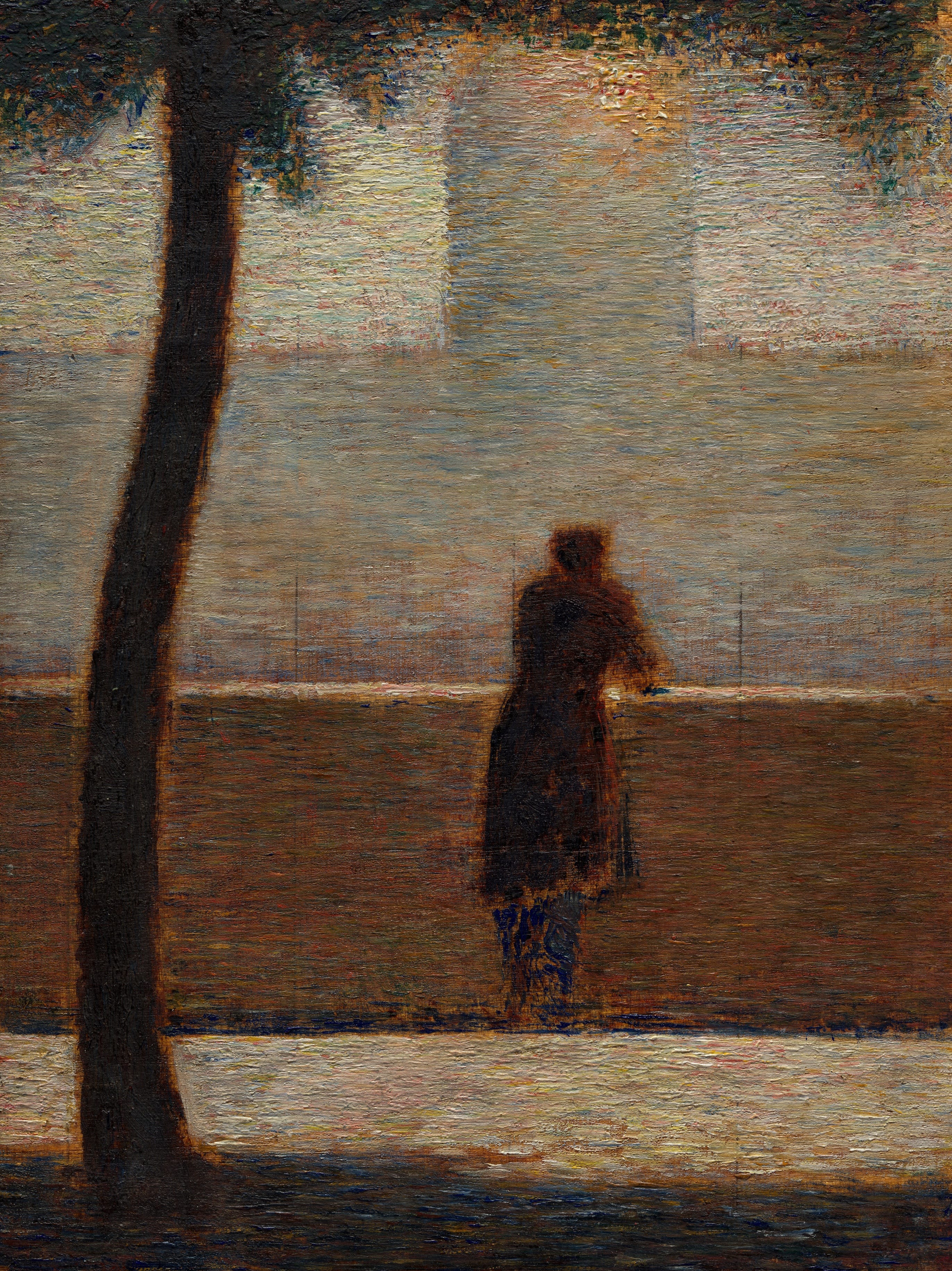
If you are looking for a beautiful, smart book about the unwieldy intersection between identity and romantic love, read The Argonauts by Maggie Nelson. In ancient Greek myth, the Argo is the ship of Jason and his crew who, after years and years at sea, must replace every plank and rope and sail. At what point, Nelson wonders, does it stop being the same ship? What what point, as we change year on year on year, are we a different self? What does that mean for love? Drawing on queer and feminist writers to think about the identity as a fluid thing, she writes her way toward answers—or at least better questions.
If you are looking for a lyrical, evocative portrait of the double-edged exhilaration of passion, read The Lover by Marguerite Duras. Based on her own experiences, it recounts the life of a young girl who seduces a much older man. This book is what I call a “bathtub read"—just long enough that, if you draw the water hot, you can read Duras’ novel in the course of one long soak.
If you want psychologically astute poetry about the intricacies of love for an imaginative mind, read The City in Which I Love You by Li Young Lee. Lee is one of my very favorite writers. His memoir The Winged Seed is one of the best I’ve ever read. His poetry is just as insightful and moving.
I vaguely remember tweeting a half-assed thought about how most important life decisions come down to considering probabilities. You’ve of course described it beautifully.